
therapeutics THAT CO-ADAPT to CIRCUMVENT resistance
Pathogens evolve resistance to therapeutics, requiring a continual flow of new therapeutics to be developed.
We proposed that it might be possible to develop interventions called Therapeutic Interfering Particles, or TIPs, that harness evolution and co-adapt with pathogens, to circumvent resistance. (see [Metzger et al. 2011] and [Weinberger et al. 2003])
TIPs are a type of molecular parasite of viruses based on the natural phenomenon of Defective Interfering Particles (DIPs) – viral deletion mutants that must compete with the wild-type virus for replication/packaging resources within the infected cell. Consequently, DIPs acts as ‘cheaters’ and deprive wild-type viruses of critical replication machinery, reducing wild-type virus production.
In contrast to DIPs, TIPs are engineered to have an in vivo basic reproductive ratio (R0) that is greater than 1 (R0>1).
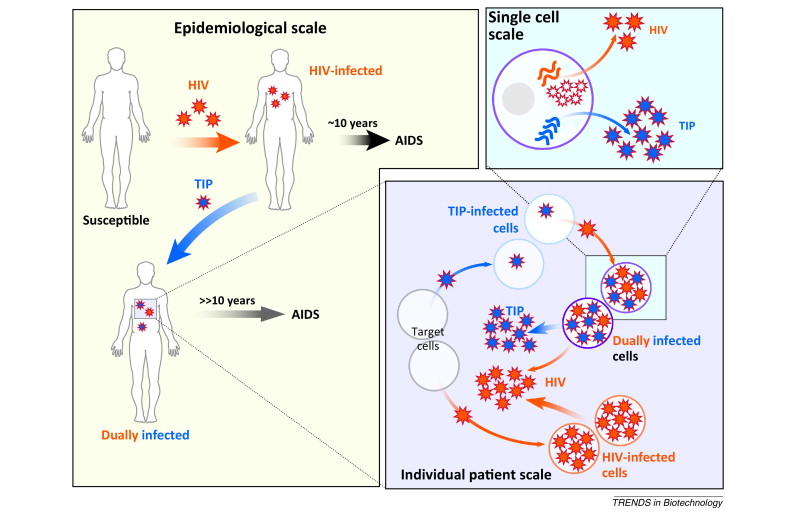
We theoretically predicted determinants required for TIP co-adaptation (Rouzine and Weinberger, 2013) and we continue to be interested in understanding molecular determinants for co-adaptation both theoretically and experimentally.
TIP-based therapies are attractive candidates for population-wide infectious-disease control, especially in resource-limited settings (Notton et al., 2014).